Case Study
Five sovereign modules on the Consumer App Pre-Built.
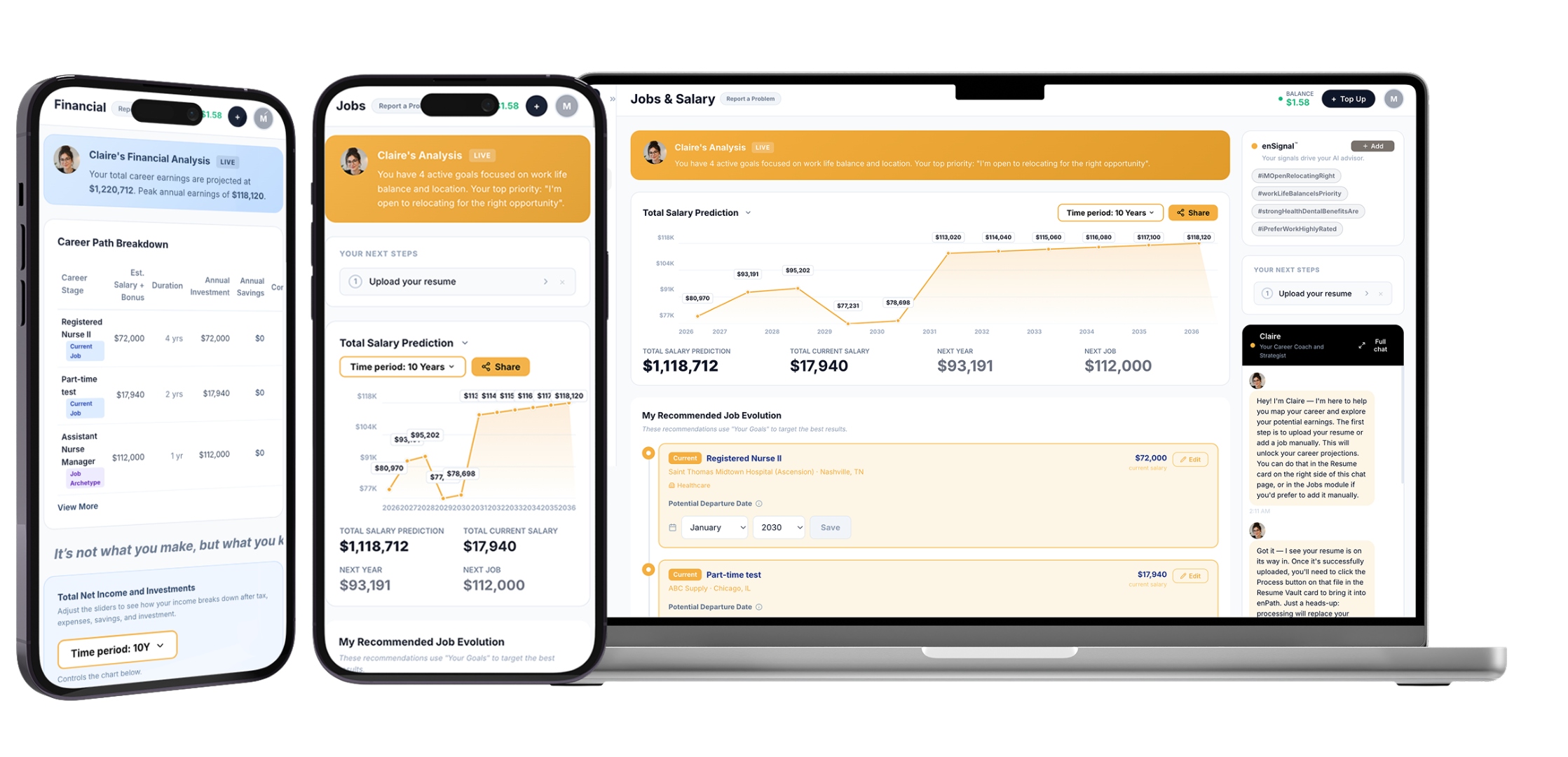
enPath is a career and life-transition platform built on the Sovereign Consumer App Pre-Built. Five sovereign modules — Jobs, Financial, Education, Community, AI Chat — plus five module-scoped AI Agents and Claire, a cross-module career strategist. Same 4-layer permission model, same Standard Module Interface, same anti-pattern discipline Freshify sells. Proven on Freshify's own product before a client is asked to trust it on theirs.
The problem
Monoliths grow, they don't compose.
Most consumer apps start as a monolith with a user table, a feed, and a login. Everything the founder wants to add next — jobs, money, learning, chat, community — gets grafted on until the app is one bloated codebase no one can safely change. Every AI feature after that is a bolt-on that pretends to know the whole product.
The decision
Start on the Sovereign Consumer App Pre-Built.
enPath started on the Sovereign Consumer App Pre-Built. Users, Companies, Workspaces, and the consumer-app surface — already sovereign, already SMI-conformant. Every new domain was then designed and built as its own sovereign module with its own sovereign AI Agent.
The modules
Five sovereign modules on top of the Pre-Built.
- Jobs — job archetypes, salary projections, career evolution planning
- Financial — net income, taxes, savings, investment modeling over a lifetime
- Education — credential ROI, education archetypes, degree and course planning
- Community — peer connection and shared planning
- AI Chat — the assistant surface
Each module is its own repo, its own database, its own deployment, its own API boundary. All conform to the Standard Module Interface. All compose against the same Users, Companies, and Workspaces layers the Pre-Built ships with.
The AI Agents
Every module ships with its own sovereign AI Agent.
- The Jobs AI Agent — reasons about roles, salary, and career progression
- The Financial AI Agent — reasons about money, taxes, and long-horizon compounding
- The Education AI Agent — reasons about credentials, degrees, and salary impact
- The Community AI Agent — reasons about peer signal and shared paths
- The AI Chat Agent — the assistant surface itself
And Claire, the cross-module career strategist. Claire is the only agent that composes across modules — she reads what the module-scoped agents produce and reasons about the whole user path. Every other agent stays inside its own module.
What sovereign actually bought enPath
- New module = new repo, not a monolith fork. Adding Community after Jobs and Education took days, not a quarter.
- Per-module AI Agents stay in scope. The Financial AI Agent doesn't drift into career advice; the Education AI Agent doesn't hallucinate account balances.
- The Pre-Built stayed untouched. Every new module composed on top. The Consumer App core is upgradeable because it was never forked.
- Data ownership is real. Each module owns its schema; cross-module data moves through explicit contracts, not shared joins.
Operational discipline the architecture makes possible
- CI/CD per module. Every sovereign module has its own pipeline. A push to Jobs deploys Jobs — not the app. Rollbacks are per-module; blast radius is one domain.
- AI QA on every merge. Automated agents review pull requests against the SMI contract, the anti-pattern catalog, and the module's own tests before a human ever looks. Regressions get caught at the boundary, not in production.
- Per-module AI token budgets. Each AI Agent runs against its own module's context — Financial doesn't load Education's data, Community doesn't load Jobs's. Token spend scales with the module, not the platform.
- AI boundaries for modifications. When an agent (or a human with an agent) modifies a module, it can only see and change that module's code, schema, and contracts. The Pre-Built stays untouched. Cross-module changes require an explicit SMI contract update — the architecture forces the conversation.
- New modules are green-field, not brownfield. Adding a sixth module doesn't require reading the other five. Same SMI, same 4-layer permissions, new repo, new pipeline.
What enPath did NOT do
- No shared user table with tenant-aware columns
- No permission checks in the UI layer
- No side-effect leakage between modules
- No "the AI Agent" that pretends to know everything
- No fork of the Consumer App Pre-Built to add features
Where it's going next
The SaaS pivot is cheap.
enPath is a consumer app today. The sovereign architecture makes the SaaS pivot cheap: adding a Companies-and-Workspaces surface for universities and corporate partners is a configuration and packaging problem, not a rebuild. Same modules, same agents, new distribution layer.
The result
enPath launched a five-module consumer platform with five sovereign AI Agents on top of the Sovereign Consumer App Pre-Built — with a full CI/CD deployment pipeline, AI-powered QA on every merge, and per-module AI boundaries that keep token spend flat as new modules ship. A clear on-ramp to a SaaS distribution model exists without touching a line of module code.
The takeaway
Sovereign Pre-Builts aren't a starting point you outgrow. They're the foundation every module a product will ever ship composes against.
Freshify first-party build on the Sovereign Consumer App Pre-Built, 2025–2026.