How the Sovereign Platform is built
The sovereign methodology, explained.
Ten sections a technical reviewer can read top-to-bottom: the code principles, the permission model, the module interface, the technology stack, the adapters that keep it swappable, how it deploys, and the twenty anti-patterns the codebase already avoids — including the discipline that lets an AI Agent attach safely to any module. Every section is documented at overview depth here. The full spec ships with Sovereign Platform.
The methodology below is not an academic argument. It’s the pattern that shows up across fifteen documented transitions — from Netflix’s seven-year cloud migration and Shopify’s modular monolith to a Finnish procurement analytics company mid-migration. Different scales, different starting points, one direction of travel. Read the stories first, then the methodology that makes them repeatable: Why Sovereign →
Section 1
Code Principles
Four principles the codebase enforces. Every module conforms to them, or the conformance suite fails the build. These are not aspirational comments in a README — they are architectural constraints the framework checks at install time.
- Modules are sovereign. Each module owns its own data, its own API, its own lifecycle, and can run on its own deployment. Nothing else reaches into a module’s collections. Modules talk to each other only through declared SMI endpoints.
- The contract is small and non-negotiable. Every module implements the same Standard Module Interface — same lifecycle hooks, same authorization surface, same event-publish rules. A module that lies about any of these fails the conformance suite.
- Permissions flow through four layers, checked in three steps. Users, Companies, Workspaces, Modules. Every request runs Module access → Function access → Data access. Any check can deny. No module invents its own permission plumbing.
- Every seam is a swappable adapter. Auth provider, database driver, cache/queue backend, deployment target — each is behind a small typed interface. Swap one, and every module comes along unchanged. Vendor choices are not baked into the code.
Section 2
The 4-Layer Permission Model
The four layers are Users, Companies, Workspaces, and Modules. They are sovereign and they compose. They are not a strict hierarchy. A User can belong to many Companies. A Company can host many Workspaces. Modules install into Workspaces but govern themselves. This is what makes zero-touch customer expansion possible.
| Layer | What it owns |
|---|---|
| Users | Identity, auth, sessions. Sovereign — owns identity end-to-end. |
| Companies | Tenant boundary. Attaches Users. Governs its own workspaces. |
| Workspaces | Named scope inside a Company. Modules install into Workspaces. |
| Modules | First-class services (Orders, Billing, Pricing…) that compose against any of the other three. |
Every request passes through three runtime checks, in order: Module access (can this user reach this module at all?) → Function access (can this user do this specific thing?) → Data access (can this user act on this specific record?). Any check can deny. Audit logs stay honest because the reasons are separable.
In practice. Every request runs the same three-check sequence, regardless of module or vertical: does this user’s role grant access to this module at all, does their role permit this specific action, and does the record itself fall inside the scope they’re allowed to act in. Any one of the three can deny, and every denial traces back to the exact layer that said no — never a single opaque 403.
What this model deliberately does not have: no global admin, no Workspace-tier "Admin" role, no implicit User → Company attachment, no hierarchical role inheritance. Every absence is deliberate. Operators use the same model as customers — the operator claim composes with tenant roles, it does not bypass them.
The four layers, the three-check sequence, and the deliberate absences are documented at overview depth. The capability vocabulary, the effective-role computation ("highest rank wins"), the per-record attachment scope, and the full operator-composition model ship with Sovereign Platform.
This is also what "built for SOC 2 / ISO 27001" means on this site: the same Module access → Function access → Data access sequence above is the concrete mechanism behind SOC 2 CC6.1 (logical access control) and ISO 27001 A.5.10 (acceptable use of assets). Those are the specific controls an auditor checks for — not a certification claim. Freshify is not SOC 2 or ISO 27001 certified today; see the FAQ below for what "built for" does and doesn't mean.
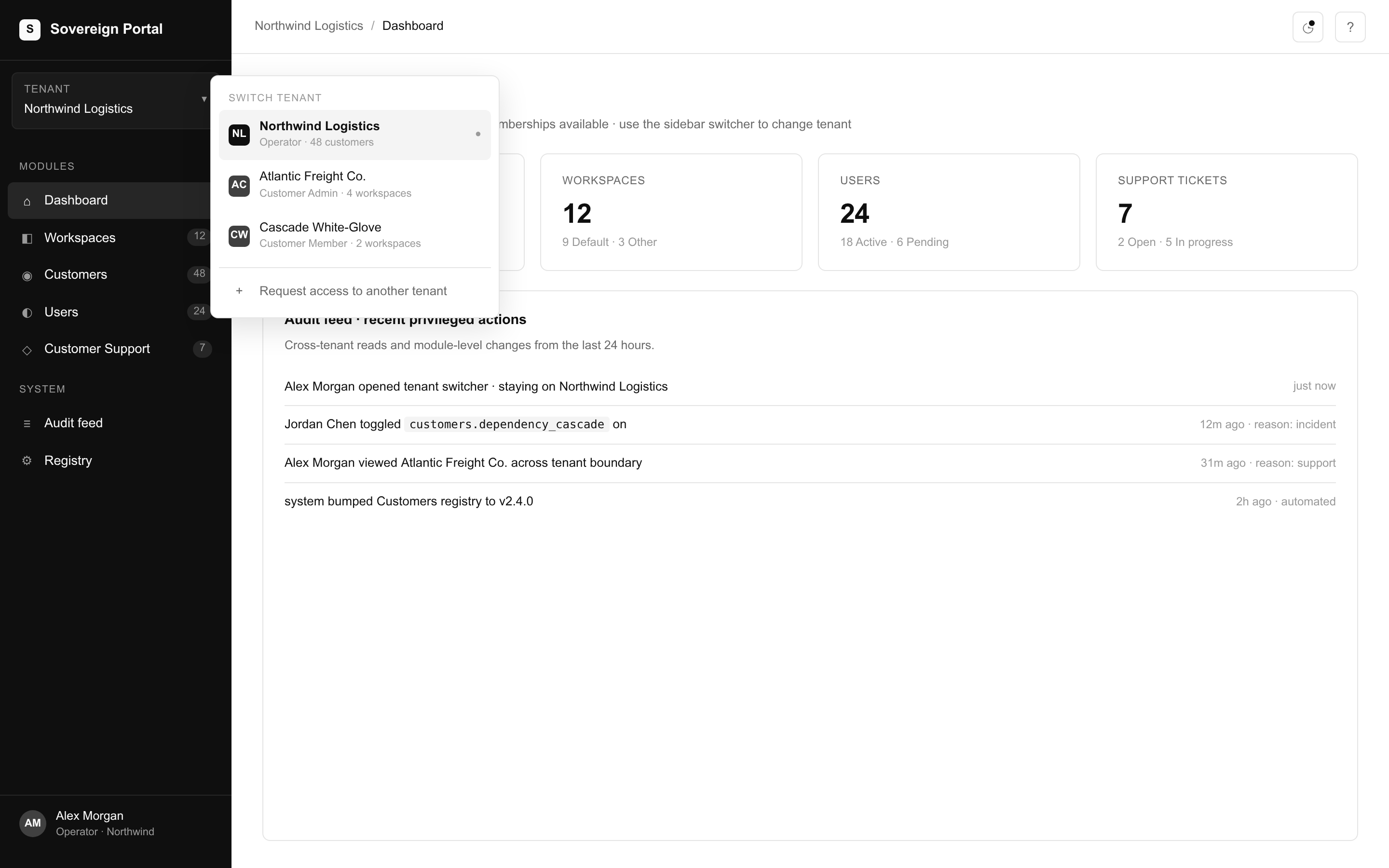
Why this image is here: it shows the User ↔ Company boundary from Section 2 in the running product — three memberships, three roles, one identity, zero cross-tenant leakage.
Section 3
The Standard Module Interface
Every sovereign module conforms to one contract. Same lifecycle hooks, same authorization surface, same event-publish rules. The framework reads modules through their registry manifest and treats every module the same way. Modules talk to each other through SMI endpoints, never through each other's internals.
The interface is small on purpose. v0.1 covers nine sections spanning identity, authorization, lifecycle, registry, API surface, events, and data ownership. v0.2 adds four amendments covering role catalogs and operator composition. Every module exports a comparably small, fixed set of methods.
What the SMI enforces: declared events are the only events a module may emit (§6). Owned collections cannot be read by another module (§7). The uninstall contract is non-negotiable (§3). A module that lies about any of these fails the conformance suite.
The sections, method signatures, and the AuthAdapter interface are documented at overview depth. The full spec, worked examples, and the conformance suite ship with Sovereign Platform.
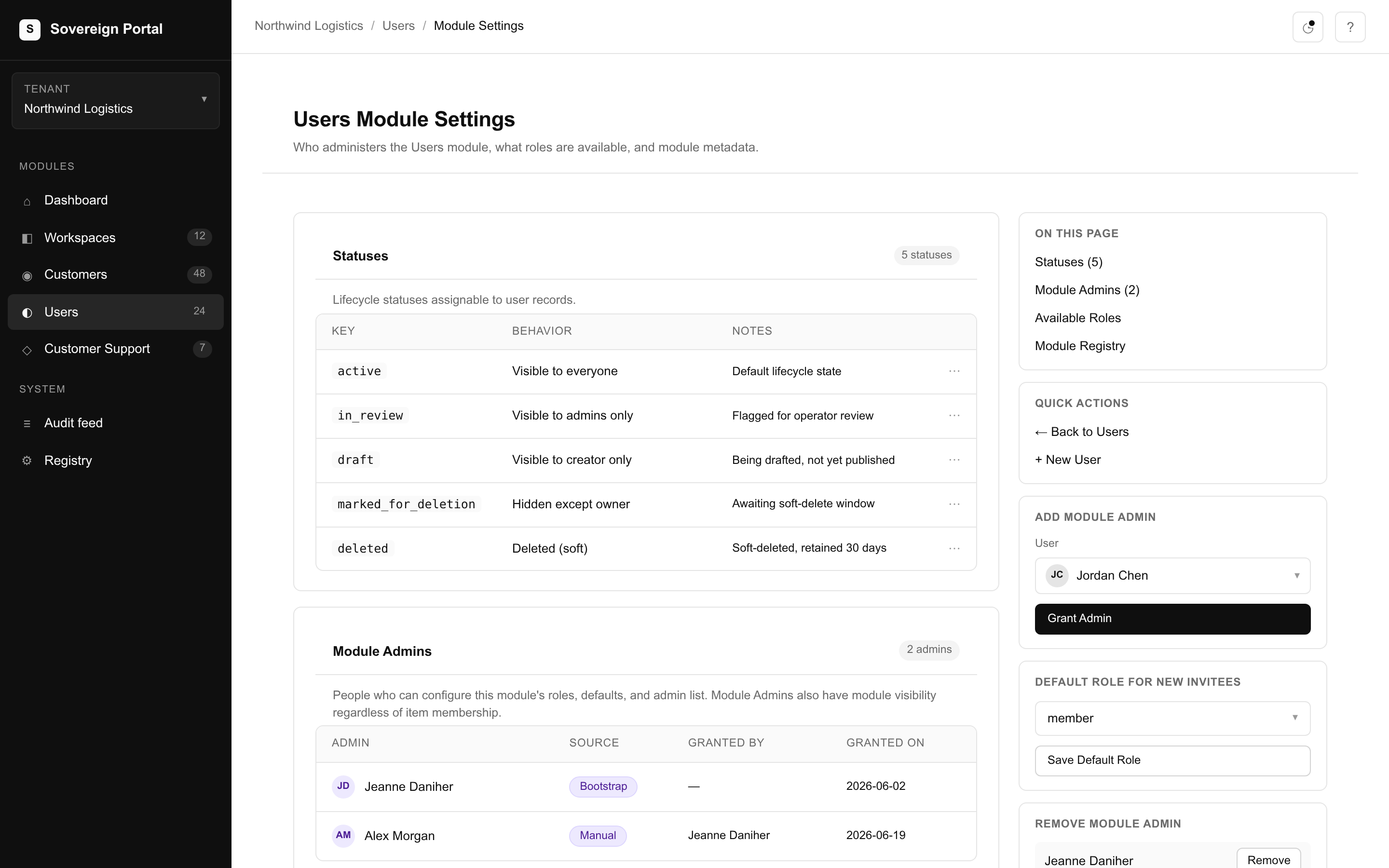
Why this image is here: it is the SMI made visible — every module renders the same statuses, admins, roles, and registry sections because they all conform to the same interface.
Section 4
The Technology
The Sovereign Platform ships as running code, not a whitepaper. Here is what is actually inside the repositories you receive on day one.
| Layer | Technology | What it does |
|---|---|---|
| Frontend | Next.js 14 App Router · React · TypeScript | The multi-tenant portal shell — tenant routing, auth, module registry, settings pages — already wired. |
| Backends | Node.js · Express · TypeScript · pino | One service per module. Structured logging. Each backend is a small, sovereign codebase you can read in an afternoon. |
| Database | MongoDB · Mongoose | Per-module schemas and connection layer, tenant-scoped, ready to extend. Each module owns its own collections. |
| Cache & Queues | Redis · BullMQ | Session storage, rate limiting, and background job processing. Every module can enqueue work without owning the infrastructure. |
| Deployment | Docker · Google Cloud Run | Each module deploys as its own Cloud Run service with its own Dockerfile. Templates and CI/CD wiring included. |
| Identity | Reference Auth Adapter · pluggable | Ships with a working adapter. Swap in Auth0, Okta, or a custom identity provider by writing a 100–300 line adapter (see §5). |
| CI/CD | Google Cloud Build · GitHub Actions | Every push to main builds a Docker image, pushes to Artifact Registry, and deploys to Cloud Run. Roughly three minutes end to end. |
| Repositories | Private GitHub repos · one per module | Cloned into your organization on delivery. Your commits, your history, your access controls. No vendor black-box. |
Every choice on this table is behind an adapter. You are not locked into MongoDB, Redis, Cloud Run, or Google — see §5.
Section 5
Swappable Adapters
The technology stack in §4 is the reference implementation. It is not the only implementation. Every seam between the framework and a vendor technology is a small typed interface. Write a new adapter, and every module comes along for free — no module code changes.
The Auth Adapter is the template. It is the only place in the framework that touches headers, cookies, or an external identity provider. Every downstream module sees a resolved IdentityContext. Swap Auth0 for Okta by writing a new adapter — every module comes along, unchanged. The adapter interface is a small, fixed set of methods covering identity resolution and the sign-in/sign-out lifecycle. Adapters are typically 100–300 lines.
Four adapters ship with the platform:
| Adapter | Reference implementation | Common alternatives |
|---|---|---|
| Auth | Ships with a working reference adapter | Auth0, Okta, Cognito, Firebase Auth, custom SAML/OIDC |
| Database | MongoDB via Mongoose | Postgres, MySQL, DynamoDB, Firestore — a Database Adapter conforms to the same contract |
| Cache & Queue | Redis + BullMQ | SQS + ElastiCache, Cloud Tasks + Memorystore, RabbitMQ + Redis |
| Deployment | Docker + Google Cloud Run | AWS Fargate, ECS, Azure Container Apps, Kubernetes, on-premise |
Why this matters for due diligence. The most common reviewer objection to a small-vendor codebase is “this locks us into their stack.” The Sovereign Platform answers: no, the code you own doesn’t import Google, Mongo, or Redis directly — it imports adapters. Switching vendors is an adapter-sized project, not a rewrite.
What is not swappable: the four-layer permission model, the SMI contract, and the anti-pattern catalog. Those are the architecture. Everything else is a choice you can change later.
Section 6
Sovereign Deployment
Sovereign deployment means each module can run on its own compute, in its own network, in its own region — independent of every other module. Coupling between modules is architectural (they share the SMI contract), not operational (they do not share a process, a container, or a database).
The reference deployment uses Google Cloud Run. Every module has its own Dockerfile, its own Cloud Run service, its own IAM identity, its own environment variables, and its own log stream. A push to main on any module's repository triggers a Cloud Build that produces a new image, pushes to Artifact Registry, and promotes it to Cloud Run. About three minutes end to end.
| Concern | How the Sovereign Platform handles it |
|---|---|
| Isolation | Each module runs in its own container, with its own service account and its own database credentials. |
| Data residency | Each module can run in its own region. EU customer data in a Frankfurt service, US customer data in Iowa — no code changes. |
| Blast radius | A crash in the Orders module cannot take down Users, Companies, or Billing. Each module fails, retries, and recovers on its own. |
| Deploy cadence | Each module ships on its own schedule. No coordinated release train, no shared deploy window. |
| Rollback | Cloud Run keeps every revision. Point traffic back to the previous revision in one command; other modules are unaffected. |
| Portability | The Deployment Adapter (see §5) means the same modules run on AWS Fargate, Azure Container Apps, or Kubernetes without code changes. |
Sovereign deployment is not about cost or performance — it is about reviewability. An acquirer can point at any module and ask “can we run this by itself, on our infrastructure, in our region?” The answer is yes, because that is how it was already designed to run.
Section 7
The Anti-Patterns Catalog
Twenty documented mistakes we caught and fixed while building sovereign modules. Each one is a specific class of bug we made hard enough to write down. They are grouped into six categories: Routing and Identity, Authorization, Data Ownership, Events and Side Effects, UI, and Agents. The Agents category covers how an AI Agent attached to a module reads and acts inside that module’s boundary — never reaching into another module’s data — which is what makes attaching an AI Agent to any module safe by construction, not by convention.
One example, in shape. Anti-pattern §17 — Treating Users, Companies, or Workspaces as framework primitives. The mistake: writing code that imports a User type from a shared framework package. Why it breaks: the moment a customer needs a second identity provider, or a new user type, or a different auth flow, the primitive has to change and every module that imported it breaks. The fix: Users is a sovereign module that conforms to the SMI like any other. Modules call /smi/users/*, not import User. The warning sign: any module has from '@framework/user' in its imports.
That is what all twenty look like: the mistake in code, why it breaks, the fix, and the warning sign. When one of these patterns lands in your codebase, you know exactly what to name and how to unwind it.
This page lists the twenty titles at overview depth. The full narratives — the mistake in code, why it breaks, the fix with diffs, and the exact warning sign — ship with Sovereign Platform.
Section 8
The Module Registry and Settings
Every sovereign module carries a declarative Module Registry — a small descriptor that says what the module is, what it depends on, what events it publishes, what collections it owns, and what capabilities it exposes. The framework consumes the registry at install time. It never trusts anything the module says at runtime that contradicts it. If the registry says the module publishes order.completed and the module tries to emit order.finished, the conformance suite fails the build.
Every module also gets an auto-rendered Settings page with four sections: Module Admins (who can configure this module in this Workspace), Available Roles (the module's role catalog), Default Role (the role auto-assigned when a member joins), and Module Registry (a read-only view of what the module declared). Module authors do not build a Settings page. They ship a registry.
The reward: adding a new module to a running portal is configuration, not a code change. No new Settings page to design. No new permission plumbing to wire. No new audit-log fields to add. The framework already knows.
The registry fields and the four Settings sections are documented at overview depth. The full field reference, worked examples, per-record attachment-scope model, and implementation checklist ship with Sovereign Platform.
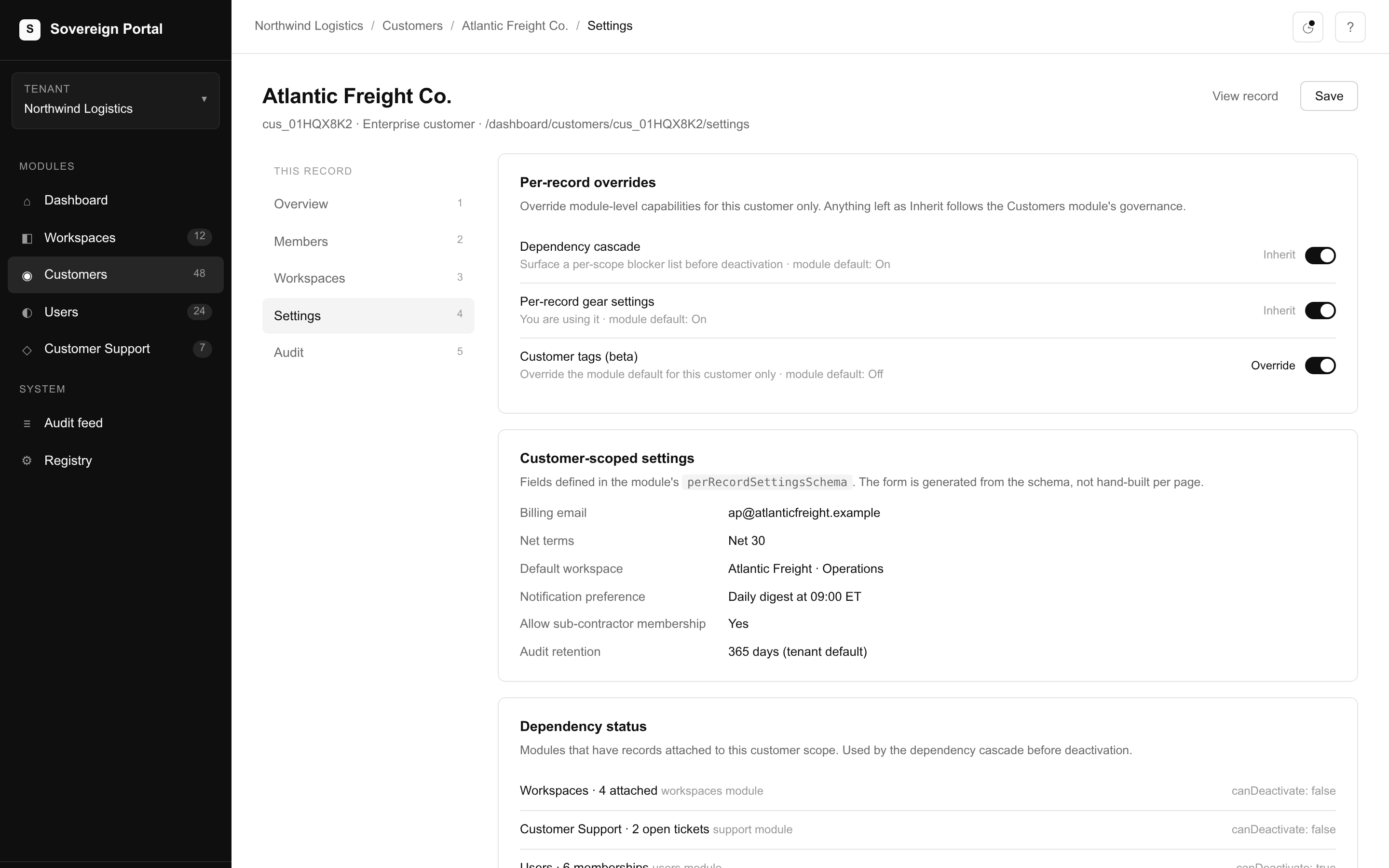
Why this image is here: it shows Registry-driven settings from Section 8 in action — the form, the inherit/override toggle, and the scope are all read from the module's registry manifest, not coded per screen.
Section 9
What sovereign means.
We use "sovereign" deliberately. It means four things:
- Sovereign data — each module owns its own schema, its own collections, its own migrations. Nothing else reaches into them.
- Sovereign API — each module owns its own endpoints. Modules talk to each other only through declared SMI surfaces.
- Sovereign lifecycle — each module can be installed, upgraded, and uninstalled independently. The uninstall contract is non-negotiable.
- Sovereign deployment — each module can run on its own Cloud Run service, its own VPC, its own region. Coupling is architectural, not operational.
The opposite of sovereign is what most legacy software is — tightly coupled, shared-database, can't-remove-one-piece-without-breaking-three-others. That is the software this methodology is designed to replace.
What this means for how you build. A solid architecture is what makes vibe coding safe. When the module boundaries, permission model, and data ownership are enforced by the framework — not by a convention your team keeps in their heads — Cursor, Claude, and Copilot can generate code inside those boundaries without breaking them. That documentation — the module templates, the interface, and the rules that keep AI assistants inside the architecture — is the Sovereign AI Knowledge Kit. And because every module’s registry (§8) already declares exactly what it owns, an AI Agent scoped to a module inherits that same boundary automatically. Vibe-code the features, the UX, the workflows, the reports. The architecture underneath was designed to hold. That is the difference between a codebase that gets faster as it grows and one that gets slower.
Section 10
How the methodology compares.
| Traditional | Sovereign | |
|---|---|---|
| Data ownership | Shared monolith database | Per-module ownership, decoupled at the schema |
| Permission model | Hardcoded roles in source | Standard role catalog, capability-driven |
| Auth | One auth service for everyone | Pluggable adapter, standard contract |
| Composition | Shared imports | Manifest-driven, framework-loaded |
| Operator access | Special admin role | Composed operator mode, same model as customers |
| Audit | Centralized log | Per-module log, framework aggregation |
| Adding a module | New code, new schema migrations, new admin UI | Registry manifest — framework renders the rest |
| Swapping a vendor | Rewrite across every module | Write a new adapter — modules unchanged |
| Deployment | One deploy pipeline, one release train | Per-module deploy, per-module rollback, per-region if needed |
FAQ
Certification questions, answered directly.
- Is the Sovereign Platform SOC 2 or ISO 27001 certified?
- No — not certified. A SOC 2 report can only be issued by a licensed CPA firm after an audit, and an ISO 27001 certificate can only be issued by an accredited certification body. Freshify holds neither today. The Sovereign Platform is built for the controls those frameworks check — SOC 2 CC6.1 (logical access control) and ISO 27001 A.5.10 (acceptable use of assets) — via the four-layer permission model and the Module, Function, and Data access checks described on this page.
- What does “built for SOC 2/ISO 27001” mean if Freshify isn't certified?
- It means the architecture already implements the specific controls an auditor would check, before any audit happens — the same four-layer model and three-check access sequence documented on this page. It's not a substitute for certification, and Freshify doesn't claim it is. If your company needs an actual SOC 2 report or ISO 27001 certificate, that's a separate audit you commission — the architecture is built so passing one doesn't require a rebuild.
Real running code. Platform depth. Architected right.
Buy Sovereign Platform to own the full spec and the reference modules. Then build the modules that make your product unique on top of a foundation that was architected right the first time.